
1: The Logistics & The “Legal” Stuff
Before you driving a tuk tuk in Sri Lanka, let’s make sure you aren’t a magnet for the local police.
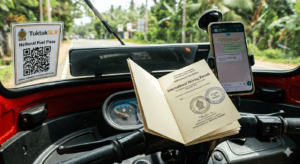
- The Physical IDP: You MUST carry a physical International Driving Permit (IDP) under the 1949 Geneva Convention. Local authorities strictly reject digital copies or e-IDPs. We use this to get your local Recognition Permit.
- The Fuel QR Code: Sri Lanka uses a National Fuel Pass system. Your tuk-tuk comes with a unique QR code.
- The 20L Quota: You are currently allocated 20 Liters per week. This quota resets every Sunday at midnight. Don’t worry—20L goes a long way in a 3-wheeler!
- Soft Luggage Only: If you brought a hard-shell suitcase, it’s going to be a bumpy ride. Stick to backpacks or duffels to fit the storage space perfectly.
2: Tuk Tuk Specifications & Fuel Guide
Knowing your machine is the first step to driving a tuk tuk in Sri Lanka successfully. Our Bajaj RE 205s are the “economy class” of the road—simple, sturdy, and reliable.
Technical Specs at a Glance
| Component | Specification / Instruction |
| Fuel Type | Unleaded 92 Octane (Yellow pump). |
| Tank Capacity | 6.5 Liters total. |
| Fuel Range | 150 km – 180 km per full tank. |
| Efficiency | ~23 km/L. Refill every 100km to be safe. |
| Reserve Tank | 1.5L (~40 km). Manually switch the lever if you sputter! |
| Max Speed | Strictly 40 km/h (Legal limit for tuk-tuks). |
3: Mastering the Controls & Gears
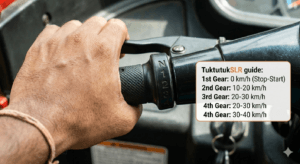
If you’ve driven a manual motorcycle or car, you’re halfway there. If not, don’t sweat it. Driving a tuk tuk in Sri Lanka is all about “The Traction Point.”
Shifting Gears Without the Crunch
The gears are on your left handlebar. Always pull the clutch in fully before twisting.
- 1st Gear: 0 km/h (Starting from a stop or steep hills).
- 2nd Gear: 10 km/h to 20 km/h.
- 3rd Gear: 20 km/h to 30 km/h.
- 4th Gear: 30 km/h to 40 km/h.
- Reverse: Ensure you are in Neutral and completely stopped before engaging the reverse lever.
Pro Tip: The Traction Point. This is the “sweet spot” where the clutch starts to bite. Release the clutch slowly; as soon as you feel the tuk-tuk shudder or move, gently open the throttle. If you drop the clutch too fast, you’ll stall—and in Sri Lankan traffic, that’s when the buses start honking!
4: Safe Driving & The “Bus Rule”
The roads here have a hierarchy, and unfortunately, the tuk-tuk is near the bottom. To stay safe while driving a tuk tuk in Sri Lanka, you must follow the unwritten laws.
1. The “Bus Rule.”
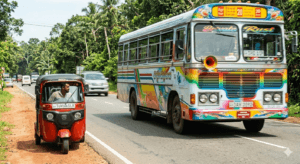
Public buses are the “Kings of the Road.” They are fast, aggressive, and rarely stop for anything smaller than them. Always give them priority. If you see a bus in your rearview mirror, pull over and let them pass. Never challenge a bus.
2. The Headlight Code
In the West, flashing lights usually mean “Go ahead.” In Sri Lanka, it means “Get out of the way, I’m coming through!” If a vehicle flashes you, slow down and move to the left.
3. Turning Corners
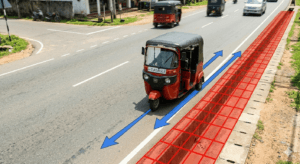
The tuk-tuk is a tripod. Your two back wheels are much wider than the front. When turning, swing out wider than you think you need to. If you cut the corner too tight, your back wheel will end up in a gutter or over a curb.
4. No Expressways
Tuk-tuks are strictly prohibited on all E-class highways (Expressways). If you see a toll booth, you’ve gone too far! Stick to the beautiful coastal and jungle roads.
5: Daily Maintenance & Security
Because we practice Preventive Maintenance, your vehicle starts in top shape. To keep it that way, perform these three checks every morning:
- Engine Oil: Check the dipstick when the engine is cold. You’ll need roughly 100ml of oil every 500km.
- Greasing: Sri Lankan roads are dusty. We recommend getting the TukTuk wheels greased every 1,000km at a local “service station” to keep the handling smooth.
- Parking Security: Always remove the key. When parking overnight, secure your rain flaps. This keeps your interior dry and discourages curious monkeys (or humans) from looking inside.
The Practical “Starter” Drill
Before you head out into the chaos of Colombo or the hills of Ella, spend 20 minutes in a quiet parking lot doing the following:
- Start the engine in Neutral.
- Shift to 1st gear.
- Slowly release the clutch until the vehicle stalls (just to find the limit).
- Restart, find the Traction Point, and move forward 5 meters.
- Stop, and find neutral.
- Repeat this 10 times.
Once you can move from a standstill without thinking about your hands, you’re ready for the road.
It usually takes about two days of driving before you feel 100% confident.